NEI Says Adults Over 60 Should Get a Dilated Eye Exam Every 1 to 2 Years; CDC Data Show Many High-Risk Adults Skip the Eye Doctor
What the exam involves, who the agencies say is at higher risk, and where their wording differs.
On this page
Key takeaways
- NEI says a dilated eye exam every 1 to 2 years is advised for people over age 60, and many eye diseases have no symptoms or warning signs.
- CDC reports that in 2017 about 93 million U.S. adults, about 4 in 10, were at high risk for vision loss, and about 40% of them had not seen an eye doctor in the prior year.
- CDC's falls page says to get a dilated eye exam at least once a year, a different interval than NEI's, so readers can ask their own eye doctor.
By the numbers
Every 1 to 2 years
Dilated exam interval for people over age 60 (NEI)
Page last updated Nov. 26, 2025
Over age 40
Age threshold for dilated exams every 1-2 years for African American adults (NEI)
Page last updated Nov. 26, 2025
At least once a year (most people)
People with diabetes or high blood pressure needing a dilated exam (NEI)
Page last updated Nov. 26, 2025
About 93 million, or about 4 in 10
U.S. adults aged 18 or older at high risk for vision loss
2017 (CDC page dated May 15, 2024)
About 40%
High-risk adults who did not see an eye doctor in the prior year
2017 (CDC page dated May 15, 2024)
More than 8 million, about 1 in 11
Adults needing eyeglasses who said they could not afford them
CDC page dated May 15, 2024; year not stated
1 in 4
Americans over 65 who fall each year
CDC page dated May 15, 2024
At least once a year
Dilated exam interval on CDC's vision-and-falls page
CDC page dated May 15, 2024
Millions (no figure given)
Americans over age 40 with vision impairment
CDC page dated May 15, 2024
What the exam is
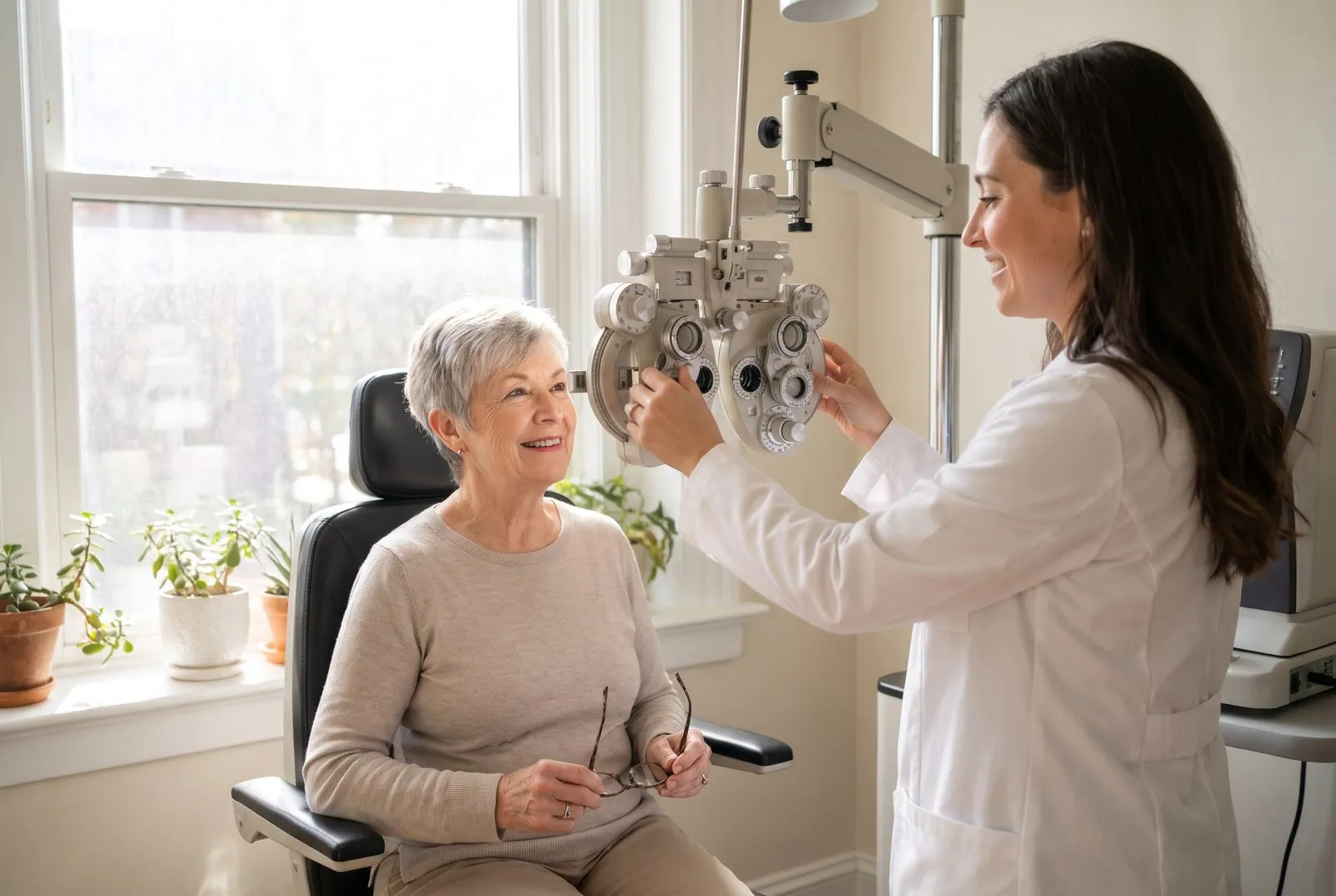
The National Eye Institute (NEI), part of the National Institutes of Health, calls a dilated eye exam the best thing a person can do for eye health, and says it is the only way to check for eye diseases early on, when they are easier to treat and before they cause vision loss. On a page last updated Nov. 26, 2025, NEI describes the exam as simple and painless.
The doctor first checks for problems that make it hard to see clearly, such as being nearsighted or farsighted, then gives eye drops to dilate, or widen, the pupil so the inner parts of the eye can be checked. NEI says dilation helps the doctor check for diabetic retinopathy, glaucoma and age-related macular degeneration, among other problems.
NEI lists the parts of the exam: a visual acuity test, a visual field test for side vision, an eye muscle function test, a pupil response test, a tonometry test to measure the pressure in the eyes, and the dilation itself. It says a doctor may add other tests depending on a person's needs.
How often, according to NEI
NEI says how often a person needs a dilated exam depends on their risk for eye disease, and that people should talk to their doctor about what is right for them. It recommends a dilated exam every 1 to 2 years for people who are over age 60, people who are African American and over age 40, and people with a family history of glaucoma.
For people with diabetes or high blood pressure, the institute says to ask a doctor how often an exam is needed, and says most people with those conditions need a dilated exam at least once a year.
The institute also says many eye diseases have no symptoms or warning signs, so a person could have a problem and not know it. Even people who think their eyes are healthy, it says, can only be sure by getting a dilated exam. After the exam, NEI says vision may be blurry and sensitive to light for a few hours, and suggests asking a friend or family member to drive.
What CDC's data show
The Centers for Disease Control and Prevention (CDC) reports that in 2017 about 93 million U.S. adults aged 18 or older, or about 4 in 10, were at high risk for vision loss. On its fast facts page, dated May 15, 2024, the agency counted as high risk those who self-reported diagnosed diabetes, had vision and eye problems, or were 65 years or older.
About 40% of those high-risk adults did not see an eye doctor or get an eye exam in the prior year, according to the page. It also says more than 8 million adults, about 1 in 11, who reported needing eyeglasses said they could not afford them.
Vision and falls
CDC ties vision to fall risk on a separate page, also dated May 15, 2024. It says millions of Americans over age 40 have vision impairment, with numbers rising as the population ages, and that each year 1 in 4 Americans over 65 has a fall, which it calls the leading cause of injury among older adults.
That page advises getting a dilated eye exam at least once a year, and says the exam can reduce the risk of irreversible vision loss and confirm that a prescription is current for people who wear glasses. NEI's interval for adults over 60 is 1 to 2 years, so the two federal pages do not word the interval identically. NEI's page itself says the right frequency depends on risk, which is a question for the person's own eye doctor.
The National Institute on Aging says that when people get new eyeglasses or contact lenses, they should take time to get used to them and wear them as their eye doctor advises.
Readers who wear glasses or have noticed changes in their sight can raise questions with their own eye doctor. Neither agency page offers a diagnosis, and NEI's page stresses that the right schedule is individual, depending on risk factors such as age, race, family history and medical conditions.
What it means for readers
- NEI says many eye diseases have no symptoms, so an exam, not a change in sight, is how some problems are found.
- NEI ties the interval to risk and says to ask your doctor; for people over 60 it names 1 to 2 years.
- CDC's data show that many people the agency classes as high risk had not had an eye exam in the prior year.
- Vision is one of several fall-risk factors the National Institute on Aging lists, along with hearing, medicines and home hazards.
Data and sources
Each figure in this report comes from the sources below. Every entry lists the organization, the date or period of the data, and the link. Links open in a new tab.
- Get a Dilated Eye ExamNEI · Last updated Nov. 26, 2025https://www.nei.nih.gov/eye-health-information/healthy-vision/finding-eye-doctor/get-dilated-eye-exam
- Fast Facts: 4 in 10 Adults at High Risk for Vision LossCDC · Page date: May 15, 2024https://www.cdc.gov/vision-health/data-research/vision-loss-facts/four-in-10-us-adults-high-risk-vision-loss.html
- About Vision Impairment and Falls Among Older AdultsCDC · Page date: May 15, 2024https://www.cdc.gov/vision-health/prevention/older-adult-falls.html
- Falls and Fractures in Older Adults: Causes and PreventionNIA · Content reviewed Sept. 12, 2022https://www.nia.nih.gov/health/falls-and-falls-prevention/falls-and-fractures-older-adults-causes-and-prevention
Related coverage
All reports
Wellness
CDC: 13.2% of Adults 65 and Older Had Lost All Their Teeth in 2017-March 2020; NIH Describes Daily Care
Tooth loss and decay figures from CDC, with brushing, flossing and dry mouth guidance from two NIH institutes.
Wellness
NIDDK: Experts Suggest a First Weight Goal of 5% to 10% Over 6 Months, and Warn Against Programs Promising 30 Pounds in 30 Days
How the National Institute of Diabetes and Digestive and Kidney Diseases describes safe programs, plus the latest figures it cites on overweight and obesity.

Wellness Habits
Study of 96 volunteers finds wide variation in how long a new daily habit takes to become automatic
University College London researchers found it took between 18 and 254 days for a new daily behavior to reach its plateau of automaticity.