Choosing a Portable Air Cleaner: EPA Says Size It to the Room and Avoid Ozone-Producing Models
The agency's consumer guide explains CADR ratings, filters for gases, placement and what these devices cannot do.
On this page
Key takeaways
- EPA says the most effective ways to improve indoor air are to reduce pollutant sources and ventilate with clean outdoor air, with filtration as a supplement.
- EPA advises choosing a portable air cleaner whose clean air delivery rate (CADR) is large enough for the room.
- EPA says to avoid air cleaners that intentionally produce ozone, a lung irritant.
By the numbers
About 90%
Share of time most people spend indoors
Page last updated October 1, 2026
8 feet
Ceiling height assumed in EPA's sizing chart
Page last updated October 1, 2026
About 50 decibels
Noise level roughly equal to a modern refrigerator
Page last updated October 1, 2026
At least MERV 13, or as high as the system can accommodate
Minimum furnace/HVAC filter rating EPA advises
Page last updated October 1, 2026
At least 50%
Minimum removal efficiency demonstrated by MERV 13 and above for the smallest particles tested
Page last updated October 1, 2026
Less than 25%
Share of time HVAC systems usually run in heating and cooling seasons
Page last updated October 1, 2026
PM 2.5 (fine) and PM 10 (coarse)
Particle sizes named by EPA as common indoor contaminants
Page last updated October 1, 2026
Filtration is a supplement
EPA's Guide to Air Cleaners in the Home, updated October 1, 2026, begins with a reminder that most people spend about 90% of their time indoors. Indoor air can contain particles, including fine PM 2.5 and coarse PM 10, as well as gases such as volatile organic compounds, formaldehyde, mold and pollen.
The agency says the most effective ways to improve indoor air are to reduce or remove pollution sources and ventilate with clean outdoor air. Research shows filtration can be an effective supplement, it says, but it does not replace source control and ventilation. EPA also states that no air cleaner or filter will eliminate all pollutants and that it does not certify or recommend specific brands or models.
Reading the CADR
EPA says most portable air cleaners carry a clean air delivery rate, or CADR. The higher the CADR, the more particles the device removes and the larger the area it can serve, with the rating usually measured at the highest speed. The rating covers particles only.
Some packaging lists separate CADRs for tobacco smoke, dust and pollen, representing small, medium and large particles. For the smallest particles of greatest health concern, EPA says to look for a high CADR for tobacco smoke. To size a unit, multiply the room's length by its width and compare the square footage with the maximum recommended on the package. EPA's sizing chart assumes an 8-foot ceiling, and for higher ceilings or open floor plans it suggests a larger unit, or several.
Gases, noise and energy labels
To filter gases, EPA advises an activated carbon filter or similar filter designed for gases, noting such filters work best when a large amount of material is used. It says no widely used performance rating exists for gas removal, and that research has not shown other technologies, such as plasma, photocatalytic oxidation or UV light, remove gases effectively in portable residential units.
For noise, some units publish ratings; EPA says around 50 decibels is roughly the sound of a modern refrigerator. An ENERGY STAR label means a unit meets efficiency guidelines, the page says, and does not describe how well it cleans air.
Placement and upkeep
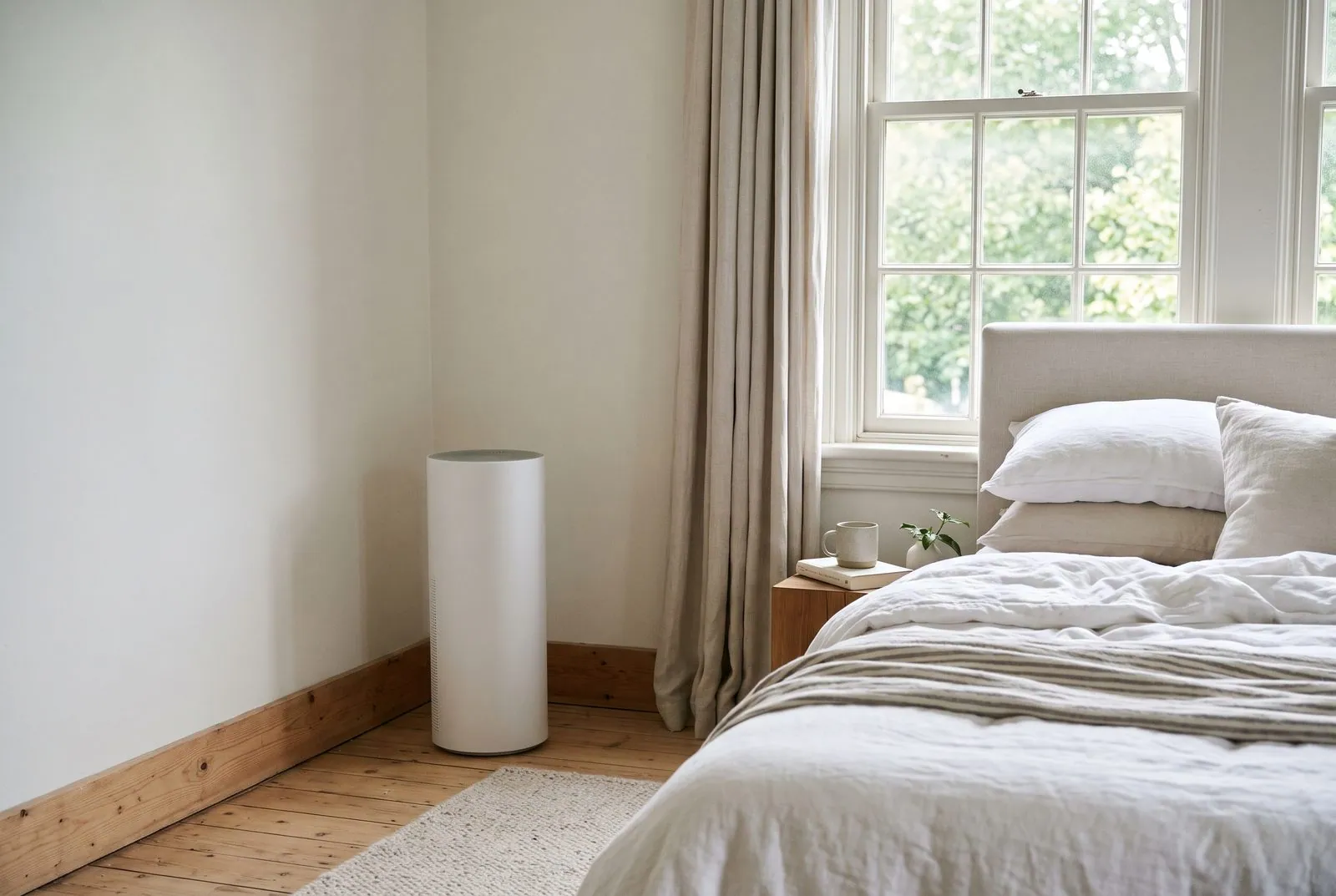
EPA suggests placing the unit in the rooms where you spend the most time, keeping airflow unobstructed and away from curtains, and redirecting the airflow if it creates an uncomfortable draft. Higher fan speeds and longer run times generally filter more air, the guide says, and all filters need regular replacement because a dirty, overloaded filter will not work well.
On ozone, EPA says to avoid air cleaners that intentionally produce it, noting that some electrostatic precipitators, ionizers, UV devices with inadequate lamp coatings and plasma cleaners could emit it. The California Air Resources Board and the Association of Home Appliance Manufacturers maintain lists of devices tested as emitting little or no ozone.
What the research suggests, and furnace filters
EPA says several studies of portable HEPA air cleaners found small improvements in cardiovascular and respiratory health, typically small and not always noticeable to the person. Multiple studies found improvement in one or more allergy or asthma symptoms, but not major improvement and not in all symptoms.
For central systems, EPA advises a furnace or HVAC filter rated at least MERV 13, or as high as the system can accommodate. It says MERV 13 and above filters must demonstrate at least 50% removal efficiency for the smallest particles tested, and that HVAC systems often run less than 25% of the time during heating and cooling seasons, so they filter only while operating.
Particles, gases and the sources of both
EPA lists common indoor pollution sources: cooking, cleaning, secondhand smoke, building materials, consumer products and home furnishings, along with pollutants that come in from outdoors. Indoor air quality varies from home to home and across a day within one home.
The guide explains that most filters are designed to catch either particles or gases, so many air cleaners include two filters, one for each, while others have only a particle filter. Consumers should check the product packaging for what a given device is designed to do. EPA adds that portable air cleaners are intended to filter a single room or area, while central furnace or HVAC filters are designed to filter air throughout a home.
What it means for readers
- Treat an air cleaner as a supplement to removing pollution sources and ventilating, as EPA advises.
- Match the CADR and room-size rating on the package to the room, and size up for ceilings above 8 feet.
- Look for an activated carbon filter if gases or odors are a concern, and avoid ozone-producing devices.
- Replace filters on schedule, since EPA says a dirty filter will not work well.
- If you use a furnace filter, EPA advises at least MERV 13 or the highest rating your system can accommodate.
Data and sources
Each figure in this report comes from the sources below. Every entry lists the organization, the date or period of the data, and the link. Links open in a new tab.
Related coverage
All reports
Air & Breathing
EPA's Air Quality Index: What the Numbers From 0 to 300 and Up Mean for Your Day
AirNow says an AQI value of 50 or below is good and a value over 300 is hazardous, with six color-coded categories in between.

Air & Breathing
Asthma Triggers Are Often Indoors, EPA Says, Where Americans Spend Up to 90 Percent of Their Time
CDC, NHLBI and EPA list dust mites, mold, pests, smoke, pollution and weather among the things that can set off asthma symptoms.

Air & Breathing
CDC: Allergic Rhinitis Affects Up to 60 Million People a Year in the U.S., and Pollen Seasons May Lengthen
The agency's pollen pages describe symptoms, everyday steps to limit exposure, and how a changing climate may affect pollen seasons.