Power Outage: Ready.gov and FDA Say a Closed Refrigerator Keeps Food Cold About Four Hours
Federal guidance gives time limits for refrigerators and full freezers and a 40-degree line for throwing food out.
On this page
Key takeaways
- Ready.gov says a refrigerator will keep food cold for about four hours and a full freezer for about 48 hours if doors stay closed.
- Both Ready.gov and FDA say to discard perishable food that has been above 40 degrees F for two hours or more.
- Ready.gov advises discarding refrigerated medication if the power is out for more than a day, unless the label says otherwise.
By the numbers
About four hours
Time a refrigerator keeps food cold with doors closed
Page last updated June 4, 2026
About 48 hours
Time a full freezer holds its temperature
Page last updated June 4, 2026
About 4 hours
Time an unopened refrigerator keeps food cold
Content current as of February 2, 2018
40 degrees or higher
Temperature at or above which Ready.gov says to throw food out
Page last updated June 4, 2026
Above 40 degrees F for two hours or more
Exposure at which perishable food should be discarded
Content current as of February 2, 2018
40 degrees or higher for two hours or more
Exposure at which Ready.gov says to throw away food
Page last updated June 4, 2026
40 degrees F or below
Refrigerator storage temperature
Content current as of February 2, 2018
More than a day
Outage length after which refrigerated medication should be discarded unless label says otherwise
Page last updated June 4, 2026
At least 20 feet
Distance generators should be from windows
Page last updated June 4, 2026
The four-hour and 48-hour figures
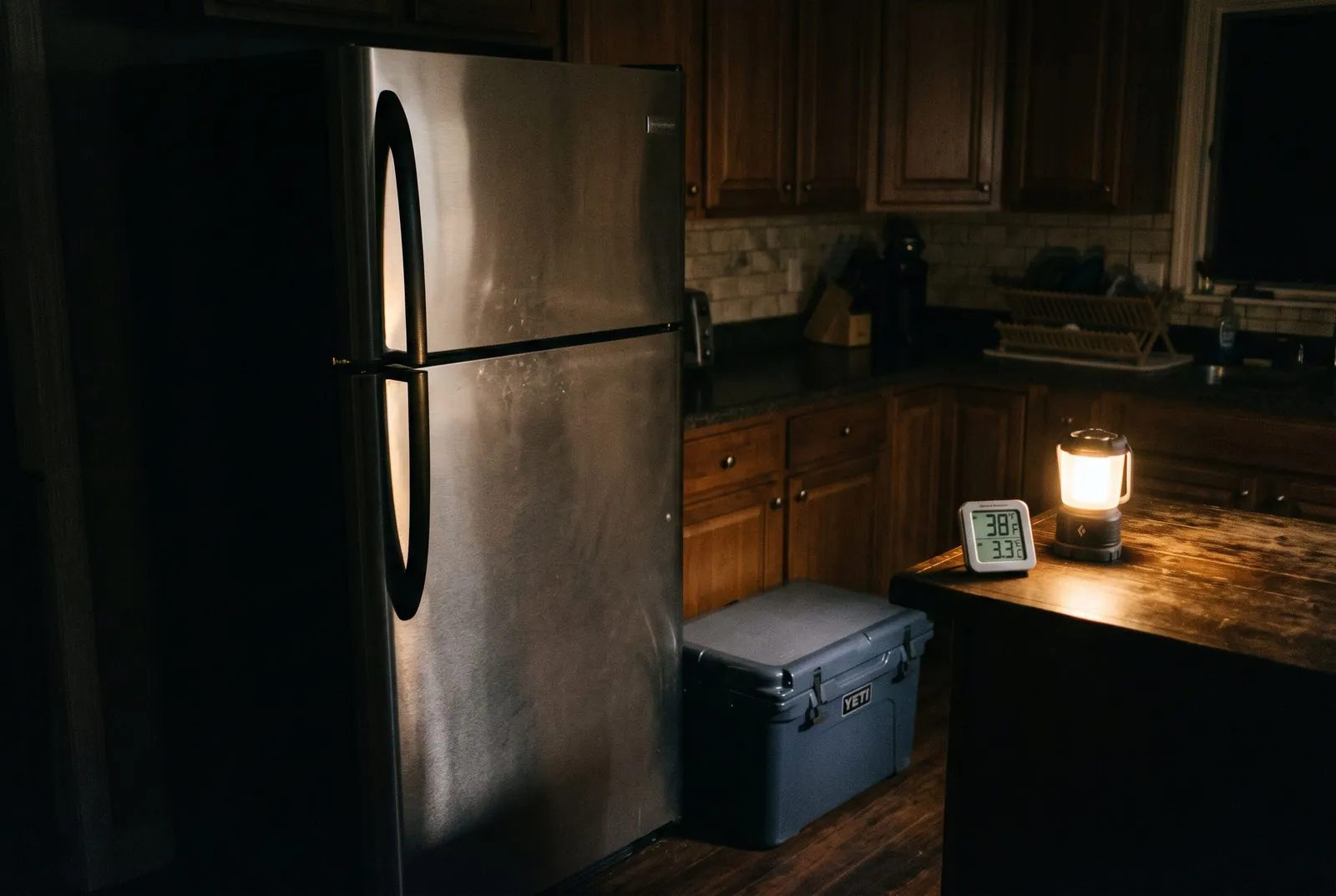
When the lights go out, the first rule from federal sources is to leave refrigerator and freezer doors shut. Ready.gov, FEMA's preparedness site, says the refrigerator will keep food cold for about four hours and that a full freezer will hold its temperature for about 48 hours. The FDA's consumer page on power outages likewise says an unopened refrigerator will keep food cold for about 4 hours.
Ready.gov adds that coolers with ice can be used if necessary, and that households should monitor temperatures with a thermometer. Its page was last updated on June 4, 2026. The FDA page shows a content-current date of February 2, 2018.
The 40-degree line
Both agencies tie safety to temperature. The FDA says refrigerators should be kept at 40 degrees F or below. Ready.gov tells people to throw out food when the temperature is 40 degrees or higher.
On the return of power, Ready.gov's advice is blunt: when in doubt, throw it out. It says to discard food that has been exposed to 40 degrees or higher for two hours or more, or that has an unusual odor, color or texture. The FDA says to discard any perishable food, such as meat, poultry, fish, eggs or leftovers, that has been above 40 degrees F for two hours or more.
Checking the freezer afterward
The FDA suggests keeping an appliance thermometer in the freezer. If it reads 40 degrees F or below when power comes back, the agency says the food is safe and may be refrozen.
Without a thermometer, the FDA says to check each package, because appearance and odor cannot be relied on. Food that still has ice crystals or is at 40 degrees F or below is safe to refreeze or cook, according to the page. For refrigerated food, the FDA says it should be safe as long as the power was out for no more than 4 hours.
Preparing ahead
The FDA's preparation tips include having a refrigerator thermometer, knowing where to get dry ice, and keeping a few days' worth of ready-to-eat foods that need no cooking or cooling. Ready.gov advises having enough nonperishable food and water, and disconnecting appliances and electronics to avoid damage from electrical surges when power returns.
Ready.gov also says to keep generators, camp stoves and charcoal grills outdoors and at least 20 feet from windows, and never to heat a home with a gas stovetop or oven, because of carbon monoxide risk.
Medicines that need refrigeration
Ready.gov advises making alternate plans for refrigerating medicines and talking to a medical provider about how long a medication can be stored at higher temperatures. It says that if the power is out for more than a day, refrigerated medication should be discarded unless the drug's label says otherwise, and that a doctor or pharmacist should be consulted promptly for a replacement.
This article is general information. Check labels and ask a pharmacist about specific products.
Why outages ripple beyond the kitchen
Ready.gov notes that extended outages can affect an entire community and the economy. A power outage may disrupt communications, water and transportation, close retail stores, grocery stores, gas stations, ATMs and banks, and cause both food spoilage and water contamination. It can also prevent the use of medical devices.
For that reason the page advises taking an inventory of the items a household relies on electricity for, planning for batteries and other power sources such as a portable charger or power bank, and having a flashlight for every household member. It also suggests checking with local officials about heating and cooling locations that are open nearby, and going to a community location with power if heat or cold becomes extreme.
The site adds that power may return with brief surges or spikes that can damage equipment, which is why it recommends turning off or disconnecting appliances and electronics during an outage. It also advises alternate plans for refrigerating medicines and for power-dependent medical devices, and a conversation with a medical provider about an outage plan for them.
What it means for readers
- Keep doors closed and watch the clock; the sources say about four hours for the refrigerator and about 48 hours for a full freezer.
- Keep a thermometer in the refrigerator and freezer so you can check for 40 degrees F.
- Discard perishable food that has been above 40 degrees F for two hours or more, and do not rely on smell or appearance.
- Ask your pharmacist now how long your refrigerated medicines can stay out, and read the labels.
- Run generators outdoors at least 20 feet from windows.
Data and sources
Each figure in this report comes from the sources below. Every entry lists the organization, the date or period of the data, and the link. Links open in a new tab.
- Power Outages | Ready.govReady.gov (FEMA) · Last Updated: 06/04/2026https://www.ready.gov/power-outages
- Power Outages: Key Tips for Consumers About Food Safety | FDAU.S. Food and Drug Administration · Content current as of: 02/02/2018https://www.fda.gov/food/food-safety-during-emergencies/power-outages-key-tips-consumers-about-food-safety
Related coverage
All reports
Preparedness
Building a Household Evacuation Plan: Ready.gov Urges Destinations in Different Directions and a Half Tank of Gas
FEMA's preparedness site walks through risks, routes, go-bags, pets and what to do before leaving the house.
Preparedness
Emergency Readiness: FDA and Ready.gov Say Keep a Medicine List, Prescription Copies and Records Backed Up
Federal guidance covers which papers to gather, how to store pills and what to do if refrigerated or flooded medicines are affected.
Preparedness
What FEMA's Ready.gov says belongs in a basic household emergency kit
The federal preparedness site lists water, food, light, communications and first-aid supplies, with a page updated July 1, 2026.